
When designing sustainable buildings, energy performance, material selection and indoor environmental quality are important considerations.
More and more construction projects are therefore being developed in accordance with international sustainability standards such as BREEAM and LEED.
It is not only the insulation of façades, floors and roofs that matters. Components integrated into the building envelope, such as roof hatches, also affect a building's thermal performance. But what makes a roof hatch sustainable, and how can it contribute to the sustainability objectives of a BREEAM or LEED project?
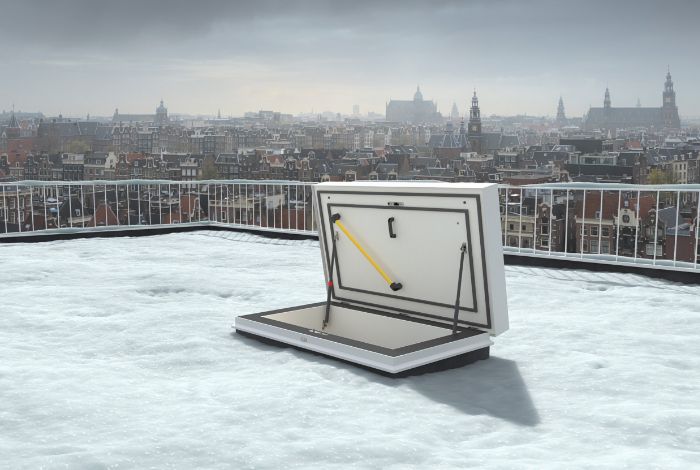
What do BREEAM and LEED mean when selecting a roof hatch?
BREEAM (Building Research Establishment Environmental Assessment Method) and LEED (Leadership in Energy and Environmental Design) are internationally recognised certification systems used to assess the sustainability performance of buildings.
Both systems evaluate various aspects of sustainability, including energy consumption, material use and indoor environmental quality.
A roof hatch itself does not receive BREEAM or LEED certification, but a building project can. However, selecting a well-insulated roof hatch with verified technical performance can contribute to achieving a project's sustainability objectives.
For architects and construction professionals, it is therefore important to consider the properties of the selected roof access solution during the design phase.
Why is a well-insulated roof hatch important?
The roof forms an important part of a building's thermal envelope. Even when a flat roof is extremely well insulated, interruptions in the roof structure can cause unwanted heat loss.
A roof hatch creates such an interruption. If its construction is insufficiently insulated or contains thermal bridges, this can affect the building's energy performance.
A sustainable roof hatch should therefore not only contain high-quality insulation material but also feature a construction that minimises thermal bridges and heat loss.
It is important to consider the Uw-value of the complete roof hatch, including the upstand, lid and profiles. This value provides a more reliable indication of insulation performance than the insulation value of the material alone.
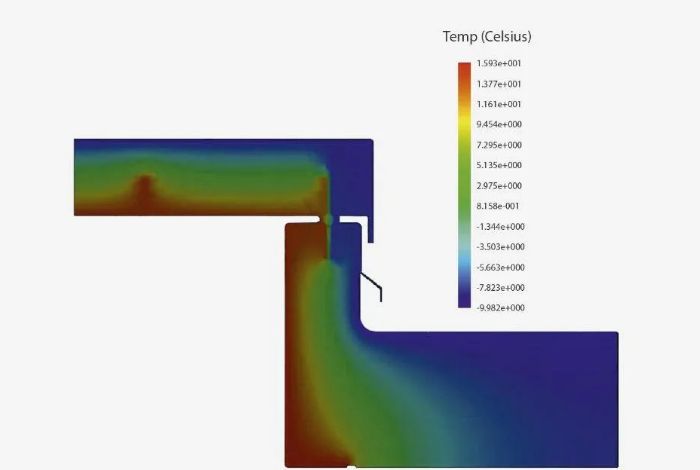
The RHTEP roof hatch: designed for high energy performance
Gorter® has developed the extra insulated RHTEP roof hatch specifically for buildings with demanding insulation requirements.
This roof hatch combines 140 mm of insulation with a fully thermally broken construction. This significantly reduces heat loss through the roof hatch while also minimising the risk of thermal bridges and condensation.
The RHTEP roof hatch has an insulation value of Uw ≤ 0.198 W/(m²·K). This value applies to the complete roof hatch construction and has been determined in accordance with EN ISO 10077-2.
Thanks to its excellent insulation performance, the RHTEP roof hatch is particularly suitable for energy-efficient buildings, Passive House concepts and construction projects aiming to achieve BREEAM or LEED certification.
Verified performance for architects and construction professionals
Like all other Gorter roof hatches, the Gorter® RHTEP roof hatch carries CE marking based on a European Technical Assessment (ETA-18/0287). This means that its product performance has been independently assessed and documented.
For architects and construction professionals, this provides a reliable basis for selecting and specifying building products. The available technical data can be used to substantiate design decisions and prepare documentation for sustainable construction projects.
Gorter® also provides technical drawings and specification texts, allowing the roof hatch to be incorporated into the building design from an early stage.
SHI certified: tested for harmful substances
Sustainable construction also involves creating a healthy indoor environment. BREEAM and LEED therefore reward the use of low-emission building materials.
Gorter® RHT roof hatches have been tested for harmful substances, including total volatile organic compounds (TVOC) and formaldehyde, by the independent Sentinel Holding Institut (SHI). They are recognised as a 'Certified Sustainable Product' and are 'QNG Ready'.
According to the SHI assessment, the roof hatches meet the requirements of BREEAM Hea 02 (Indoor Air Quality) and the LEED v4.1 Low-Emitting Materials credit, and are suitable for DGNB and BNB certification schemes. The SHI product passport can be used directly as supporting evidence in project documentation.
Read more about the SHI certification of the Gorter RHT roof hatch.

Sustainable in use: safe roof access for maintenance
A sustainable building should not only be energy efficient but also allow for effective maintenance throughout its service life.
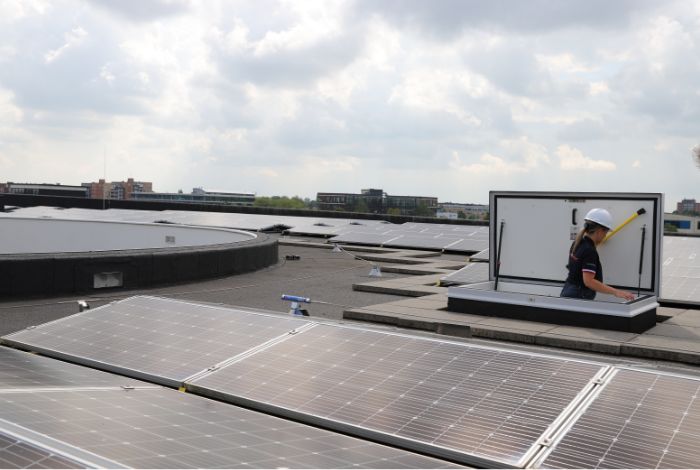
Flat roofs are increasingly equipped with solar panels, HVAC systems and other technical installations. These installations must remain safely accessible for inspection, maintenance and potential replacement.
Gorter® provides complete roof access solutions that combine a roof hatch with a matching ladder, scissor stair or fixed staircase.
These combinations are designed to work together and, depending on the configuration, can be supplied with TÜV NORD certification. This ensures that both the building's energy performance and safe, practical roof access are taken into consideration.
Need advice for your sustainable construction project?
Are you working on a new-build or renovation project where BREEAM, LEED or high insulation performance plays an important role?
Explore the possibilities of the extra insulated RHTEP roof hatch or contact the Gorter® specialists.
 YouTube
 Pinterest
 X
 Instagram


